
Rematriation as Care: Visiting the Ancestors in Berlin
According to Ruby Satele, a PhD candidate from Sāmoa at the University of Vienna, rematriation involves not only the return of ancestors, but also practices of care while they remain in storage. Her research combines strong theoretical thinking with practical action to challenge power imbalances and promote greater justice in museums and universities. In this visit, she cared for the ancestors through direct contact, prayers, and gifts offered to them in storage, creating positive experiences for the ancestors during their time in Europe.
On the 16th of December 2025, I was specially joined by Fox Satele and Lucy Satele, and together we were welcomed by Bernhard Heeb (Prehistorian and Curator) and Barbara Tessmann (Archaeologist and Anthropologist) for a special visit to the Museum of Pre- and Early History at the Berlin State Museums. The museum holds eight skulls of ancestors from Sāmoa. Although they were removed from Sāmoa, they originally come from Sāmoa, the Solomon Islands (Malaita), and possibly other parts of Melanesia.
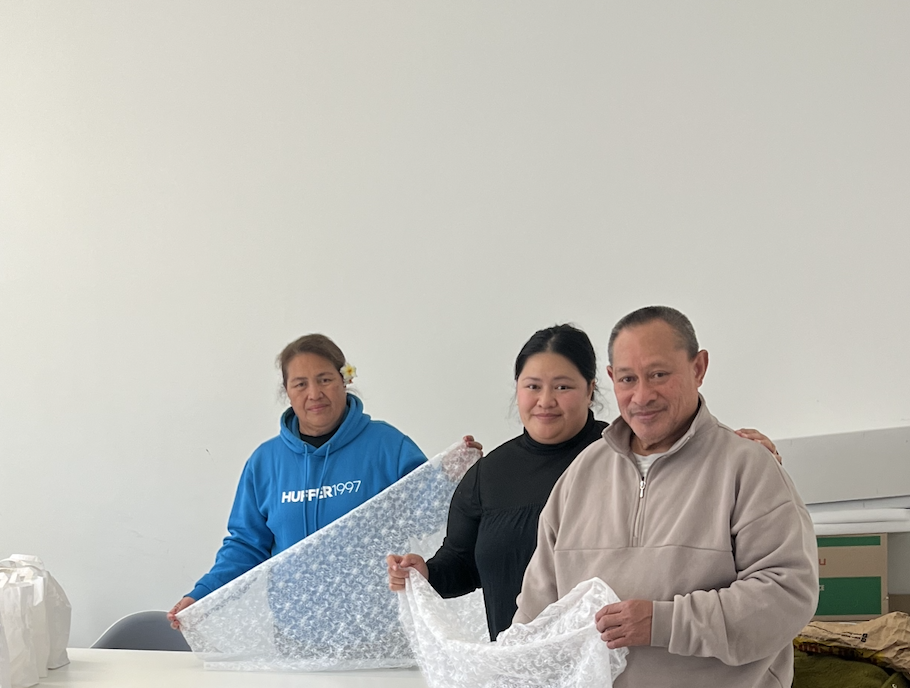
Lucy, Ruby and Fox. (PC Bernhard Heeb).
Our visit began with a feiloa’iga (formal greeting) led by Fox, a community leader and a Sāmoan chief and orator. He began with a lauga (formal oration) to feiloa’i (greet) the ancestors. Lucy and I then joined him in singing the hymn “Families Can Be Together Forever,” after which he conducted a lotu (prayer) for blessings over the ancestors’ spirits, the institution, and our time together. This formality concluded with each of us presenting a ula (lei, garland) to each ancestor’s skull.
After an interval from ritual, I proceeded with a visual inspection, recording physical descriptions and handwritten inscriptions. Fox and Lucy supported me in this process, and I noticed that the language they used to describe the ancestors’ physical aspects was of the higher Sāmoan language. We allowed ourselves to speak openly and broadly about the ancestors, imagining scenarios, circumstances, aftermaths, and potential legacies of their mortal and postmortal lives.
Towards the end of our visit, Fox asked to take on the task of laying the ancestors back into their museum houses or packing units, which he did with the support of Bernhard and Barbara. He carefully placed their skulls into the packing units, while Lucy laid a white lace over them as a form of ufimata (veil over the eyes), afīfī (wrapping), or fa’aafu (to burn up or warm up), and finally returned their ula. We sang a Sāmoan lament, Mo’omo’oga Sa Molia I Talosaga, to farewell the ancestors until such a time when we hope to see them again.
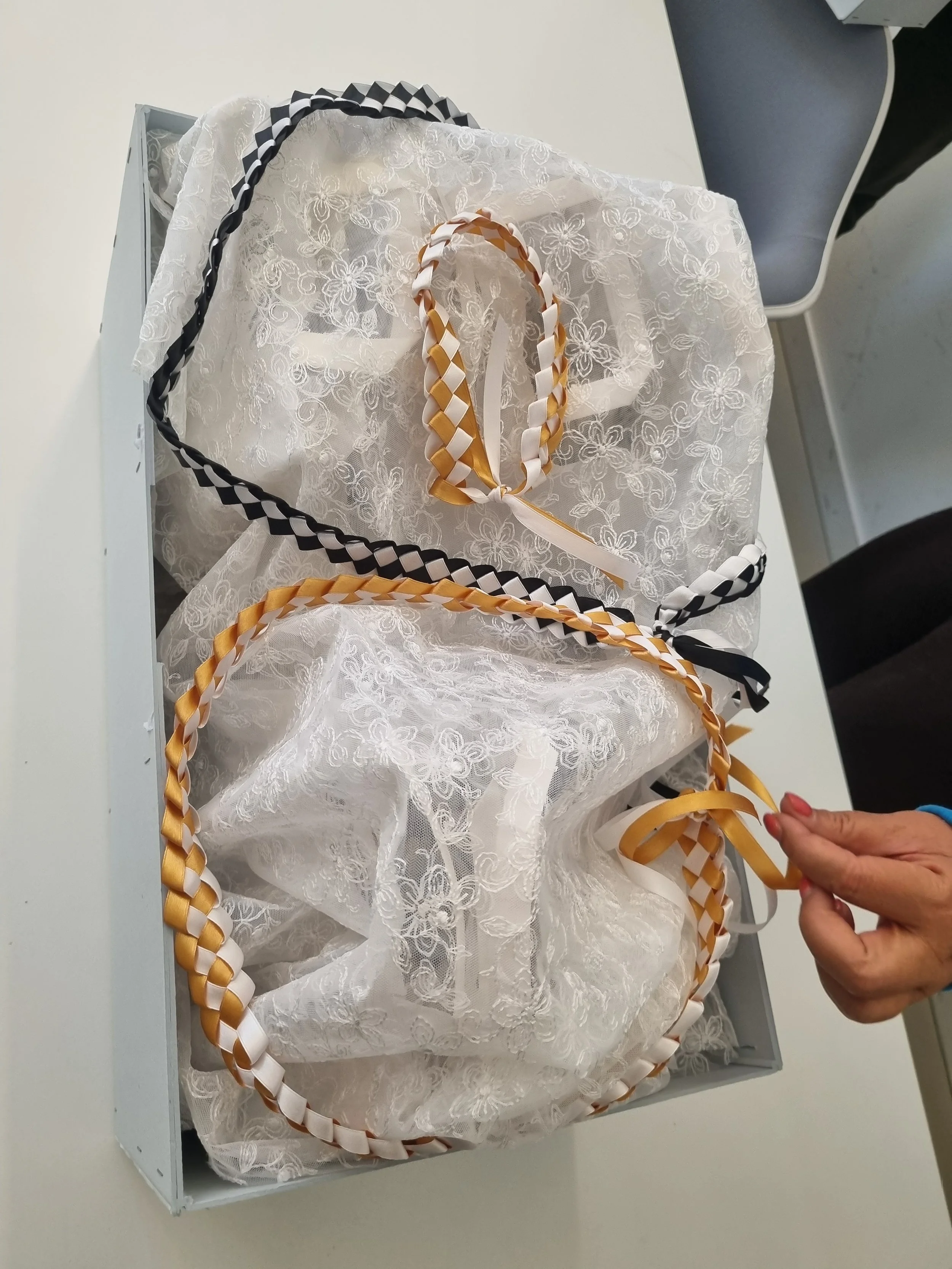
Ancestors in packing units (PC Author).
This visit was supported by the GloCo project and the European Research Council.