
Visiting Colleagues at the Vatican’s Anima Mundi Museum
by Renée Riedler
In May 21-22 I visited the Anima Mundi Ethnological Museum at the Vatican, home to the missionary collections and personal gifts presented to the Pope over centuries. The visit became an opportunity not only to reconnect with Ellen Pearlstein, Professor Emerita at UCLA, but also to meet conservation colleagues Serena Francone (MUCIV–Museo delle Civiltà), Catherine Riviére and her outstanding team, as well as museum curator Romina Cometti.
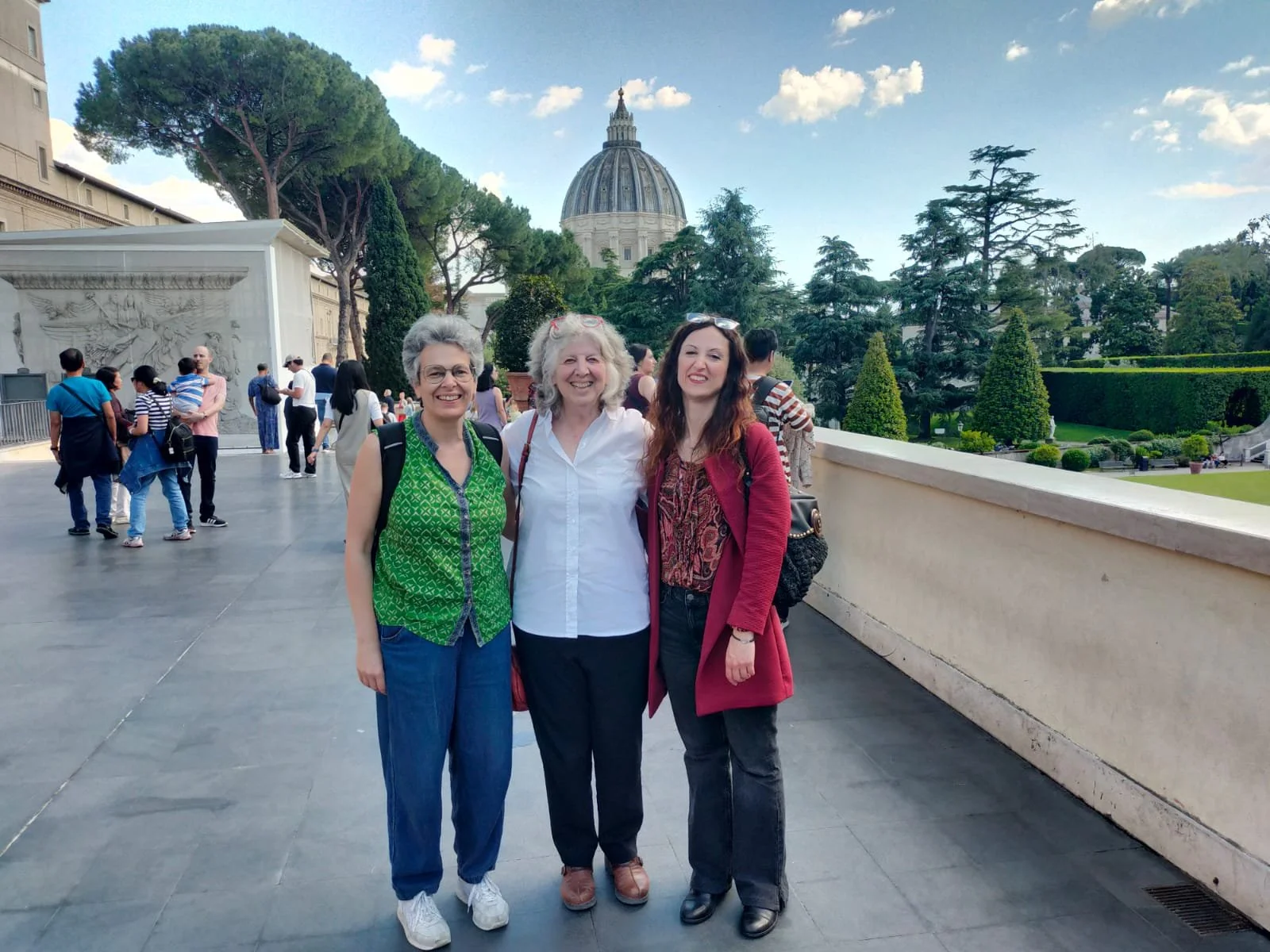
Renée Riedler with Ellen Pearlstein and Serena Francone.
Back in 2022, Ellen began researching a group of Central Yup’ik masks from western Alaska held in the Vatican collection. Since then, she has wondered whether Jesuit missionaries may have helped create the masks, as they have been collected in haste for the Pontifical Missionary Exhibition (PME) at the Vatican for the 1925 Jubilee Year.
“Would these masks be considered less authentic, even if some were created with the assistance of missionaries?”
As part of Ellen’s research, she connected the museum with Chuna McIntyre, a Yup’ik artist and performer of traditional Yupi’k dance and song. His knowledge opened new ways of understanding the masks, both technically, culturally and spiritually.
The curator at the time, Father Mapelli, had written labels for the masks that removed their spirituality. Chuna and Ellen both thought it was because the spirituality wasn’t Catholic and Chuna considered it a triumph when it was understood that the masks are spiritual!
Although some of the masks may have been created for purposes other than sacred or ceremonial use, and later modified within the museum, they are still understood as carrying significant intangible authenticity.
“It is profound that spiritual masks could be materially modified through restoration and still hold meaning”
Since then, the museum has continued collaborating with Chuna, and we were curious to see how this relationship would appear in the recently opened Americas gallery. Romina Cometti met us at the entrance and led us away from the crowds of the Vatican into the quiet museum space.
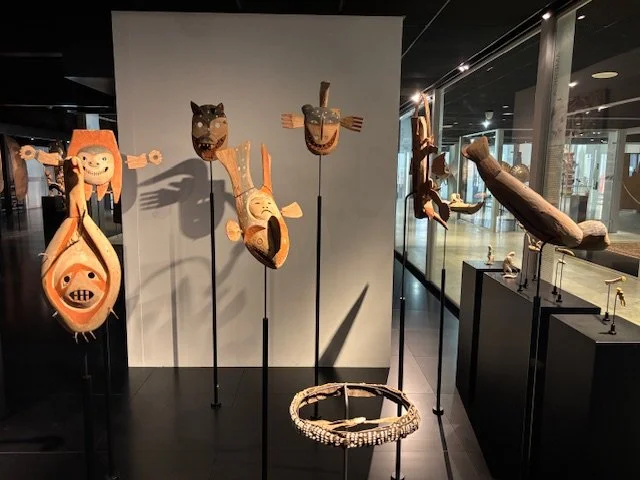
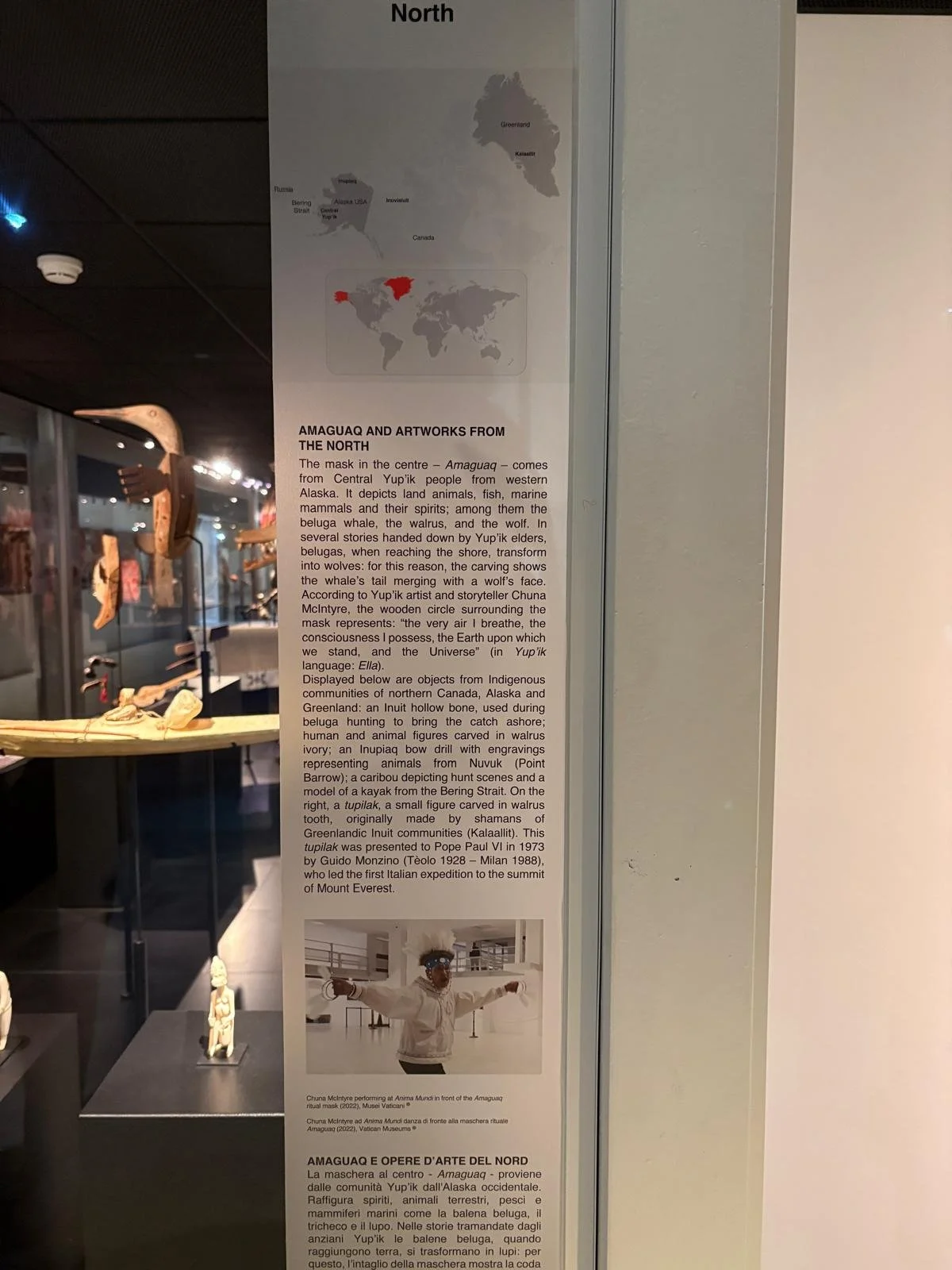
The galleries follow a contemporary ethnographic approach, with minimalist design and very limited contextual information. While visually striking, the display leaves much unsaid. Without prior knowledge of the project, visitors could easily miss the depth of collaboration behind the masks altogether. The layered histories and cultural significance carried by the Yup’ik masks remain largely invisible. Only a discreet label and an image of Chuna performing in the gallery hint at the collaboration behind the exhibition.
Thanks to the work of Romina Cometti, Ellen Pearlstein, Chuna McIntyre, and Serena Pandzy, the collaboration’s extensive research, insights, and findings have been preserved through a series of publications.
Cometti, Romina. “Seven sacred Yup’ik ceremonial masks.” Bollettino dei Monumenti Musei e Gallerie Pontificie XLII (2024): 269–308. Vatican City: Edizioni Musei Vaticani, 2025
Pearlstein, Ellen, and Chuna McIntyre. “Traditional and Conservation Interpretations of Pre- and Post-Collection Working Methods for Alaskan Yup’ik Masks.” Studies in Conservation 69, no. 4 (2024): 285–297.
Pearlstein, Ellen, Chuna McIntyre, and Serena Pandozy. “Central Yup’ik Masks in the Vatican Museums: Indigenous American Heritage in European Museums.” Museum Management and Curatorship 38, no. 6 (2023): 620–642.