
by Ayesha Fuentes
“If you don’t have this conversation beforehand, it is just colonialism.”
Gaël de Guichen – former ICCROM special advisor – in response to a question about changing definitions of conservation around the world, Oslo 2026.
In September this year, I attended the International Council of Museum – Committee on Conservation (ICOM-CC) Triennial Conference in Oslo. One week long with over 1000 participants from six continents – and though the majority of attendees were from northern Europe or large institutions with financial support for professional development – we heard from Sámi conservators working in the north of Norway, Ugandan colleagues who had developed a mobile exhibition about medicinal plants, researchers working to develop local conservation guidance with Indigenous groups in Colombia, and colleagues working in conflict regions or in response to natural disasters.
As coordinator for the ICOM-CONSERVATION working group on Theory, History, and Ethics of Conservation, it is is my responsibility to review papers submitted for the conference preprints, moderate discussions during our sessions at the meeting, and solicit feedback from my colleagues. Amongst all our variety and discourse, many conversations have been oriented around questions of expertise and how conservation is defined across different bodies of historical, ecological or institutional knowledge. I repeatedly hear my colleagues say that this is key to both the social and material sustainability of our field- but how do we have this discussion? And with whom? And how do we make the information that we cultivate useful to broader groups of colleagues and heritage stakeholders?
Whose knowledge defines conservation?
Based on my experience working across diverse cultural and institutional settings, the unilateral translation of established definitions of conservation seems like a scientific dead end. Even approaching material care as something that can be translated – standardised, transmitted, controlled for accuracy, etc. – reflects a social, economic and epistemological position that is not universal in practice. Moreover, having worked with prehistoric stone tools from around the world I have seen some of the oldest surviving evidence that people have been fixing and maintaining valued materials for as long as we have been utilising them. Yet conservation as a global profession currently maintains historical narratives, values and standards largely shaped by European art history and colonial collecting practices including an emphasis on material integrity, stability and the misunderstanding that conservation – like science – is the unique product of Enlightenment thinking.
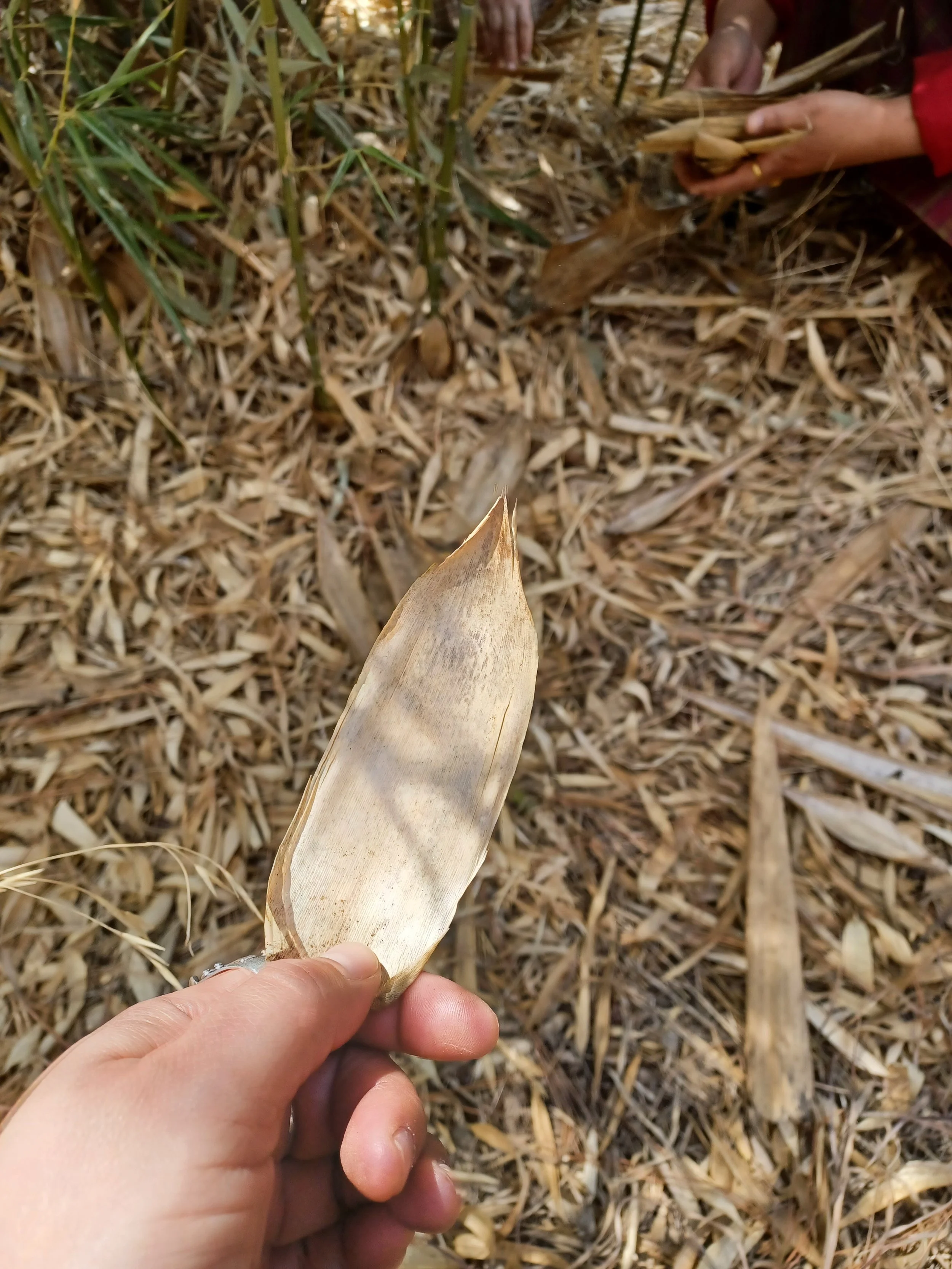
Because it is prohibitively expensive for heritage workers and museum professionals to import materials to Bhutan, local conservators experiment with what is available to them. This bamboo leaf was used to make an unsuccessful prototype for a fill material on a natural history specimen; it was tested successfully against locally-made paper toned with acrylic paint.
The limits of professional practice
Many conservators recognise that our methods, narratives and professional vocabularies are constantly evolving: Reflecting on his five decades of work in the sector, it is an awareness of our changing standards that resonates in M. de Guichen’s above comment on translating conservation into new settings as a potentially ‘colonial’ exercise. However, because conservators are often employed as technicians rather than research leaders – and increasingly as temporary external contractors – we frequently lack access to resources for professional development, engagement, interdisciplinary collaboration or the management of global networks. The result is that while conservation practitioners can see the larger epistemological problems that come with translating our expertise across different learning contexts, we do not always have the capacity to address them.
Learning from an unfinished glossary
Fortunately, conservation is an empirical tradition that combines of material knowledge, scientific analysis, risk assessment, documentation, skilled practice and creative fabrication. We understand that experimentation and prototypes can be useful, that some problems need to be solved collaboratively, and that some challenges may not have solutions but nevertheless must be tested.
We also know the satisfaction of finding unexpected results in the data we collect. In my time as a Visiting Fellow with the GloCo project, I have reflected on how their expanding Glossary is useful to our field as well as how the impact of this project and its methodologies might be measured. I have found that the breadth and depth of information assembled in the GloCo Glossary – and how it has been made accessible as both a process and an archive – can facilitate communication between different types of conservation practitioner about the limits of our expertise, professional identity, and how we engage with diverse communities of practice. At the same time, this project has demonstrated that a consolidated global definition for conservation could never be complete. The lack of resolution feels liberating.
See also De Guichen, G. 2026. The untold story of ICOM-CC terminology: Building a consensus. In Cultural Connections in Conservation. ICOM-CC 21st Triennial Conference Preprints, Oslo, 14–18 September 2026, ed. J. Bridgland. Paris: International Council of Museums. Available here.
Ayesha Fuentes is a conservator and joins the GloCo project at the University of Vienna as a Visiting Fellow during the winter semester 2026/27.